VR Quest with Oyen
Design, development, and research for a grant-funded mobile VR museum app.
Collaborator
UNIMAS
Role
Research Assistant
Scope
Design, Develope, R&D
Year
2026

The Quick Facts
Project Lead
Duration
Stack
Key Achievements
The Research & Commercial Challenge
Physical museums face localized geographic constraints, limiting global access to cultural heritage assets. While Virtual Reality (VR) offers an immersive alternative, deployment often stalls due to two major barriers: the high hardware cost of premium tethered VR systems, and a lack of empirical research demonstrating whether gamified immersive experiences actually improve knowledge acquisition compared to traditional media.
As the Research Assistant, my objective was to engineer an accessible, low-overhead mobile VR platform that brings the exhibits of the Chinese History Museum to life, while systematically measuring its quantitative impact on user engagement across varied learning demographics.
The Objective
To map out a fluid UX flow, engineer a stable mobile VR app supporting both casual 360-degree telemetry and gamified logic loops, capture high-fidelity 3D environments upon museum approval, and execute an iterative testing pipeline culminating in a controlled 400-participant data collection study.
🎨 Architectural Design: Spatial Interaction & User Flow Mapping
To visually demonstrate system dependencies, state machine transitions, and UI logic loops to technical recruiters, the system’s runtime framework was meticulously mapped out in Figma.

Technical Breakdown of the Figma Logic Matrix
The interaction flow maps a dual-branch architecture tailored around hardware constraints and spatial UI limitations:
Asynchronous Branch Routing: Users segment at the home layout into either a passive, low-friction environment exploration loop (VR 360 Tour) or a state-driven progression channel (VR Quest).
Gaze-Based Spatial Interaction: Because mobile VR headsets lack external hand-tracking controllers, the interface relies completely on a hardware-agnostic Gaze Hotspot Matrix. Users trigger actions (such as opening doors or advancing scenes) by sustaining visual focus on interactive vector coordinate hubs.
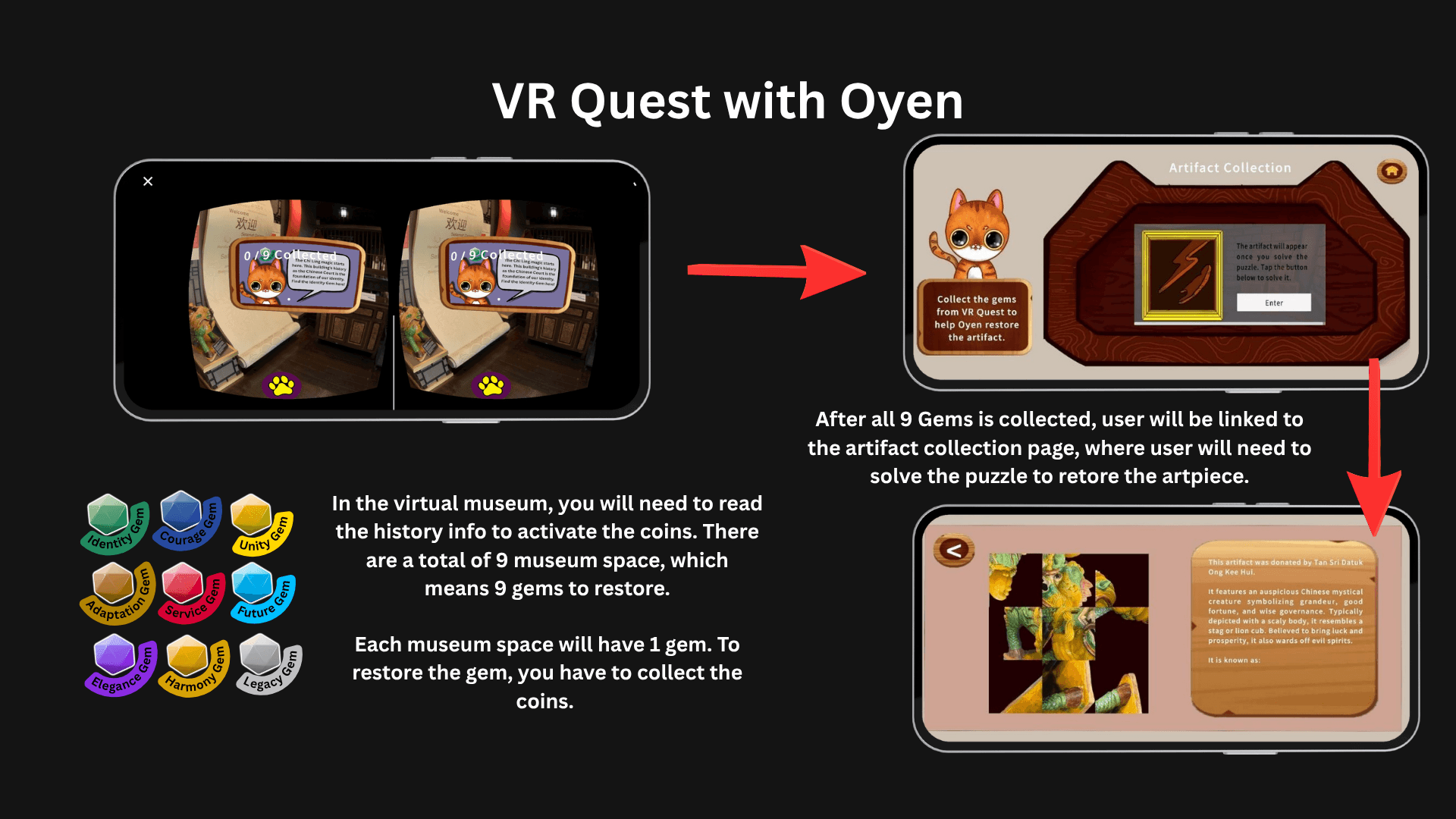
State-Driven Gatekeeping: The VR Quest pipeline enforces strict variable tracking. The user must collect all 9 hidden virtual gems to satisfy a global boolean state, which sequentially unlocks the structural door collider leading to the Artifact Collection Page.
Artifact Image Puzzle: Upon room transition, the application loads an interactive historical asset module. Users execute a localized tap-to-rotate sequence to mechanically align fragmented images of a museum artifact in spatial coordinate space, updating the state machine to reveal hidden educational metadata.
🛠️ Field Engineering & Iterative Deployment Lifecycle
Parallel Path Engineering (App Architecture Build)
To optimize the project timeline, I engineered the core Unity 3D infrastructure, logic routing, and gaze-interaction C# scripts first while asynchronously navigating government channels to secure official clearance from the Museum Department.
Spatial Asset Acquisition & Finalization
Upon receiving formal approval, I executed a fast-tracked 2-week field data-gathering pipeline inside the Chinese History Museum. Using Insta360 hardware, I captured high-fidelity panoramic environments, processed them into optimized skyboxes, integrated them into the pre-built Unity engine loops, and finalized the application build.
Pilot Testing & Feedback Integration
Before deploying the system at scale, I conducted a pilot test with 31 participants to gather targeted baseline usability metrics. To protect the proprietary findings of our upcoming research publication, only the primary spatial user experience updates were integrated into this public project log:
Spatial Presence Upgrades: Users noted a desire for deeper spatial context within the puzzle interfaces. I refactored the UI scenes to render contextual ambient background elements of the museum rather than a sterile layout void.
Proprioceptive Optimization: To reduce spatial detachment inherent to mobile VR, I integrated static virtual hands into the viewing camera viewport matrix to ground the user's spatial alignment and sense of scale during interaction loops.
These are the updated layout of the VR Quest.
Empirical HCI Research Work (Active Phase)
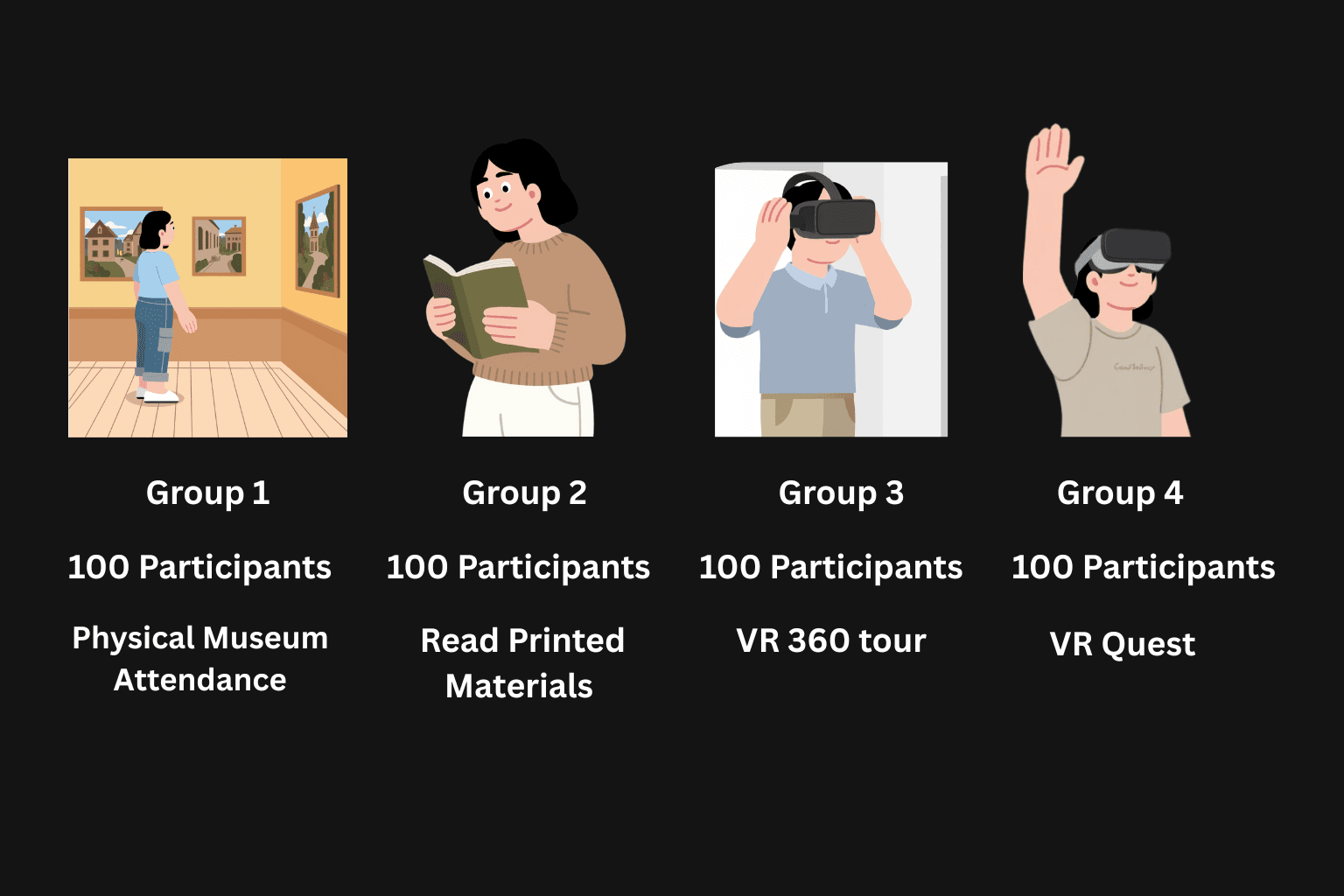
Following the targeted pilot optimizations, the application entered the large-scale empirical data collection phase. To ensure zero overlap with standard professional business hours, participant coordination is scheduled and conducted strictly during weekends. I am managing a controlled sample matrix of N = 400 participants, perfectly distributed across four distinct experimental cohorts:
📈 Validated Research & Practical Value
Algorithmic UX Benchmarking
Quantitative feedback collected from the active 400-user data collection phase will be statistically analyzed to map precisely how immersive gamification (the tap-to-rotate artifact image puzzle and gem loop) influences user retention rates compared to passive viewing.
