
VRG Museum App
Immersive VR Gamification for Cultural Tourism Marketing.
Collaborator
UNIMAS
Role
Research Assistant
Scope
Design, Develope, R&D
Year
2022
The Quick Facts
Project Lead
Duration
Stack
Key Achievements
💡 The Big Picture
When pandemic travel restrictions hit, Sarawak’s rich cultural museums went quiet. Traditional, text-heavy websites simply weren't engaging enough to attract remote visitors, resulting in a steep drop in engagement. To bridge this gap, I designed and engineered a mobile VR application that completely transforms cultural education into an immersive 3D maze game. Global users can now explore the digital halls of the Sarawak Textile Museum and Chinese History Museum, interact with historical artifacts, and solve educational quiz boards to collect reward tokens—all from their smartphones.
🎨 The Design Process (UI/UX)
From a design perspective, my priority was creating a seamless experience that eliminated the typical friction and motion sickness associated with mobile VR. I started by mapping out intuitive user flows from the initial app launch straight into the VR environment, ensuring a smooth transition for the user. To keep users oriented, I designed a smart digital floor plan that serves as an effortless wayfinding system. To showcase advanced prototyping principles, I utilized Figma to reverse-engineer and document the app's high-fidelity layouts, specifically designing the cross-dimensional user flows that bridge the flat 2D main menus with the landscape VR modes. This clearly demonstrates how a user navigates from standard 2D smartphone interfaces directly into immersive 3D space, showing solid structural logic for complex platform transitions.
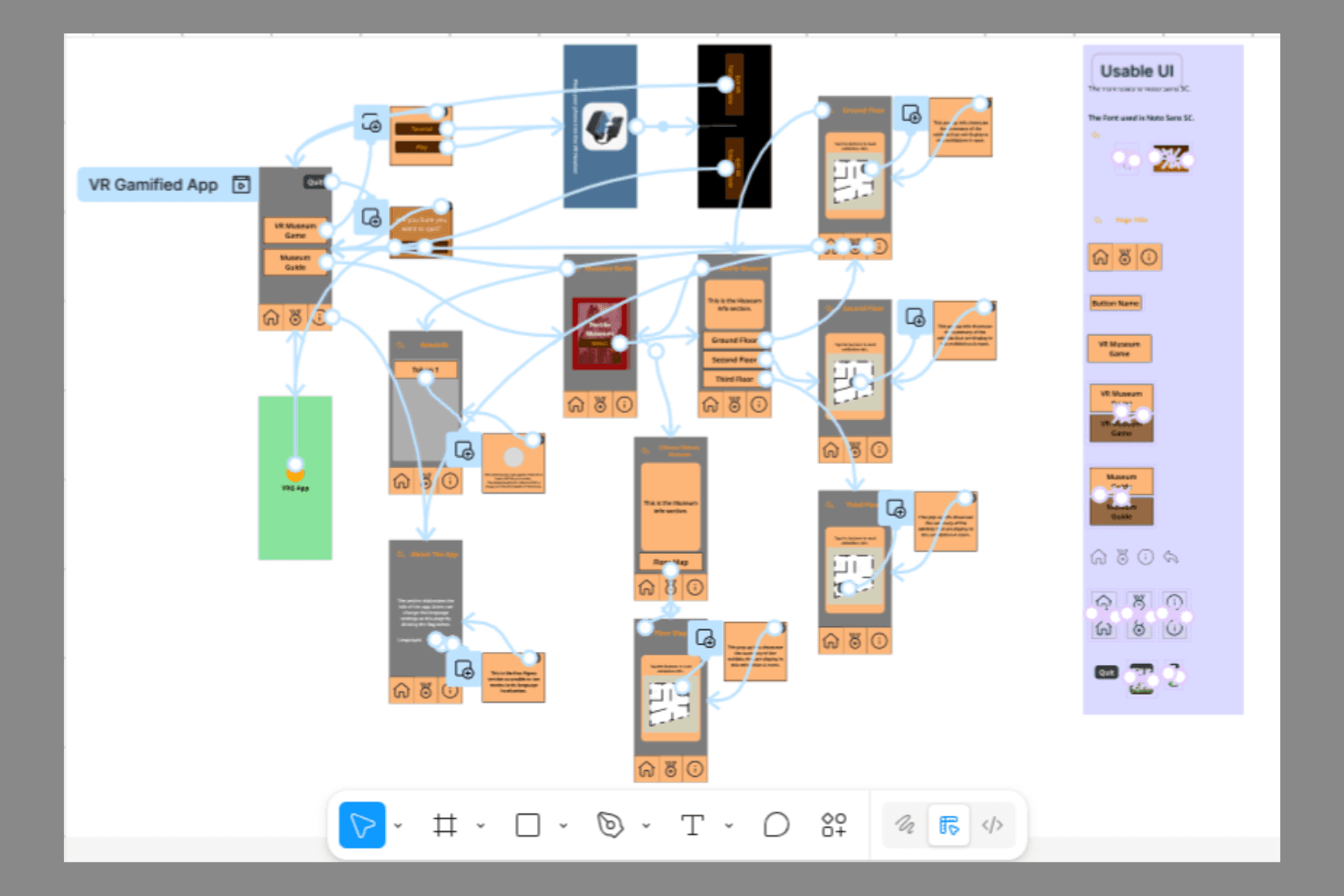
Architectural map outlining the interaction logic and user flow mapping.
🔗 Explore the Architecture Assets:
⚙️ The Engineering (Software Development)
On the engineering side, I utilized Unity 3D to program and deploy a fully functional, cross-platform app within a strict one-month timeline. I handled the core gameplay architecture in C#, scripting the mechanics for the 3D maze environment and the educational quiz board logic. Specifically, I programmed a conditional reward loop: when a user inputs the correct answer on a quiz board, a hidden treasure is activated within the maze. Once triggered by the player, this unlocks a collectible token that dynamically updates and displays on their reward page. To ensure the app remained accessible without expensive hardware, I engineered a hands-free gaze selection system using Unity Raycasting, allowing users to interact with quiz boards and tokens just by looking at them.
📈 Proof It Works (Results & Awards)
We didn't just build this and hope for the best; we backed it up with a comprehensive 10-month data collection phase, running empirical testing with 90 target users. The data conclusively proved that this gamified VR model achieved significantly higher user retention and knowledge absorption than traditional digital platforms. This innovation earned a Silver Award at the Invention, Innovation and Design Exposition (iidex2022) and a Merit Award at the Innovation and Technology Exposition (InTEX22). Additionally, the system architecture and research findings met all grant requirements and were officially published in a peer-reviewed Q2 Scopus-Indexed Journal this year (2026).
🔗 Read the Published Research:
Watch our presentation for iidex2022! This video shows the original version I built for my Final Year Project (FYP) that won the Silver Award, right before we started the big 10-month user testing phase.
🧠 Post-Mortem & Next-Gen Upgrades
Every great project comes with valuable technical and design lessons, and real-world testing highlighted exactly where the system can be optimized. For instance, forcing a portrait-to-landscape screen rotation when transitioning into VR mode caused minor onboarding friction for users inserting their phones into headsets. Furthermore, using static graphic images for buttons led to unexpected UI stretching on non-standard smartphone aspect ratios.
To take this application to the next level, my strategic roadmap for future iterations includes:
Refactoring the initialization flow to launch the application natively in landscape mode with a premium, museum-aligned aesthetic.
Upgrading the UI components by replacing raster graphics with dynamic, vector-based Unity UI elements for flawless cross-platform screen scaling.
Enhancing the asset pipeline by moving toward advanced Blender modeling and 3D photogrammetry scanning to replicate historical artifacts with absolute precision.
